
When evaluating talking flash card machines, B2B buyers naturally focus on the electronic device itself—the audio chip, the battery, the plastic casing. However, the physical flashcards are handled far more frequently than the machine. They are bent, chewed, spilled on, and stepped on by toddlers daily. If the cards degrade quickly, the entire product becomes useless, leading to immediate customer complaints and high return rates. Understanding the material science of the flashcards is crucial for B2B buyers aiming to deliver a premium, durable educational product.
Why Do Standard Flashcards Fail in the Hands of Toddlers?
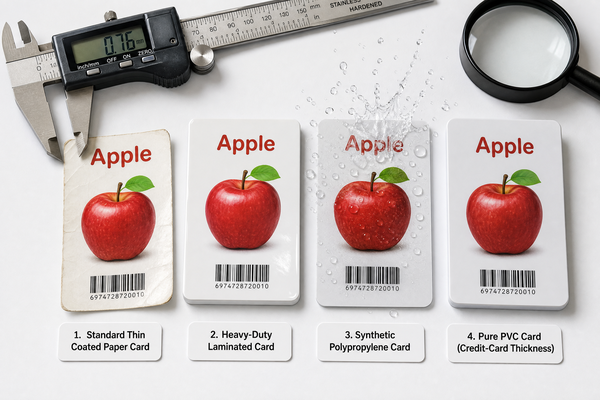
The vast majority of cheap talking flash cards sourced from entry-level factories use standard 250g or 300g coated paper. While this material is inexpensive and prints beautifully, it is entirely unsuitable for the rigorous environment of early childhood play.
Standard coated paper has very low tear resistance. A toddler can easily rip a card in half. Furthermore, it is highly susceptible to moisture. A single spill of juice or saliva will cause the paper to warp, delaminate, and ultimately destroy the barcode printed on the card. Once the barcode is unreadable by the machine’s optical sensor, the card is dead. The American Academy of Pediatrics (AAP) emphasizes that toys designed for children under five must be capable of withstanding mouthing and frequent sanitization without degrading [1]. Standard paper fails both criteria.
How to Choose the Right Material for Premium Flashcards?
To prevent damage and customer complaints, B2B buyers must specify upgraded materials during the OEM/ODM process. There are three primary material upgrades available from high-quality manufacturers:
- Heavy-Duty Laminated Paper (350g – 400g): This is the first step up from standard paper. The core is a thicker, denser paperboard, and it is sealed on both sides with a robust PET (Polyethylene Terephthalate) lamination film. This provides excellent water resistance (spills can be wiped off) and significantly increases tear resistance. It is the most cost-effective upgrade for premium retail brands.
- Synthetic Paper (Polypropylene/PP): Synthetic paper is not actually paper; it is a specialized plastic film that looks and feels like premium matte paper. It is completely waterproof, highly tear-resistant, and does not delaminate because it is a single solid substrate. It is an excellent choice for institutional markets (schools and daycares) where durability is paramount.
- Pure PVC Cards: Similar to the material used for credit cards, PVC cards are virtually indestructible in the hands of a toddler. They cannot be torn, they are completely waterproof, and they can be rigorously sanitized. However, they are significantly more expensive and heavier, which increases shipping costs.
Flashcard Material Comparison Matrix
| Material Type | Tear Resistance | Water Resistance | Cost Impact | Best Application |
|---|---|---|---|---|
| Standard Coated Paper (300g) | Low | Low | Baseline | Budget retail, promotional items |
| Heavy-Duty Laminated (400g) | High | Medium-High | +15% to 20% | Premium retail, Amazon FBA |
| Synthetic Paper (PP) | Very High | High (Waterproof) | +30% to 40% | Educational institutions, premium brands |
| Pure PVC | Indestructible | Ultimate (Waterproof) | +80% to 100% | Special education, clinical therapy tools |
Why Does Ink Quality Matter as Much as the Material?
Choosing a durable substrate like synthetic paper is only half the battle. The ink used to print the vibrant images and the critical barcode must also be highly durable and safe.
Cheap factories often use standard offset printing inks that can scratch off or fade over time. More concerningly, these inks may contain trace amounts of heavy metals or volatile organic compounds (VOCs). B2B buyers must insist that the factory uses soy-based or eco-friendly UV-cured inks. These inks bond permanently to the lamination or synthetic paper, preventing scratching and fading. Furthermore, they guarantee compliance with strict chemical safety standards like ASTM F963 and EN71. The World Health Organization (WHO) stresses the importance of eliminating toxic chemicals from materials frequently mouthed by young children [2].
How Toyvao Guarantees Flashcard Durability
At Toyvao, we know that a talking flash card machine is only as good as the cards it reads. We offer our B2B partners a wide range of premium, ultra-durable card materials designed to withstand the toughest toddlers.
We utilize advanced Heidelberg printing presses and premium UV-cured, soy-based inks to ensure vibrant, scratch-resistant, and 100% non-toxic printing. Whether you require heavy-duty laminated cards for a premium Amazon brand or indestructible synthetic paper for a school district tender, Toyvao has the manufacturing capability to deliver. Partner with us to eliminate customer complaints and build a reputation for unyielding quality.
References
[1] American Academy of Pediatrics (AAP). “Selecting Appropriate Toys for Young Children in the Digital Era.”
[2] World Health Organization (WHO). “Children’s Environmental Health: Toxic Chemicals.”
[3] Grand View Research. “Educational Toys Market Size, Share & Trends Analysis Report.”
Want to upgrade your flashcard materials and eliminate customer complaints? Contact Toyvao today!
Email: sales@toyvao.com | WhatsApp: https://wa.me/8618681064480
Related Articles
Useful Resources
