As the global demand for interactive educational toys continues to surge, B2B buyers, Amazon FBA private label sellers, and educational brands are increasingly sourcing custom talking flash cards. According to a market report by Grand View Research, the global educational toys market size was valued at USD 68.2 billion in 2024 and is expected to grow at a compound annual growth rate (CAGR) of 7.6% from 2025 to 2030 [1]. This growth is largely driven by parents and educators seeking high-quality, interactive tools to enhance early childhood literacy and cognitive development.
For international buyers looking to partner with a Chinese toy manufacturer, one of the most critical initial hurdles is understanding and negotiating the Minimum Order Quantity (MOQ). MOQ is not just an arbitrary number set by factories; it is a direct reflection of production efficiency, material procurement constraints, and safety compliance requirements.
In this comprehensive B2B sourcing guide, we will break down the standard MOQ tiers for custom talking flash cards, explain why Chinese factories enforce these limits, and share practical strategies to negotiate flexible terms for your brand.
1. Standard MOQ Tiers for Custom Talking Flash Cards
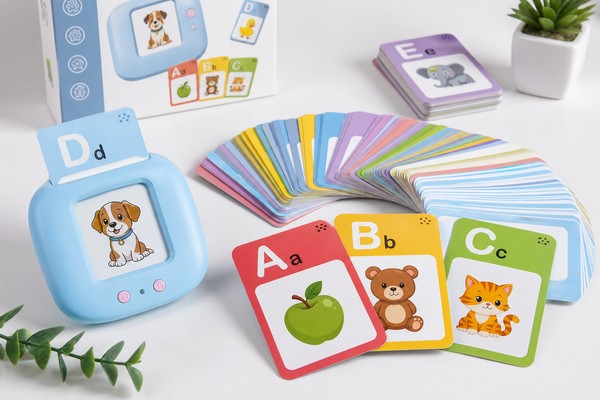
When sourcing talking flash cards from China, the MOQ is highly dependent on the level of customization you require. The more custom elements you introduce—such as custom card decks, bespoke audio recordings, bilingual programming, or custom-shaped plastic readers—the higher the production setup costs, which in turn increases the MOQ.
To help you plan your procurement budget, we have categorized the standard industry MOQ tiers based on different levels of customization:
| Sourcing Option | Customization Level | Standard MOQ (Units) | Typical Lead Time | Best Suited For |
|---|---|---|---|---|
| Wholesale / White Label | Stock products, standard packaging, pre-loaded English audio. | 100 – 500 | 7 – 10 Days | Startups, local retail test runs, low-budget projects. |
| Custom Packaging (OEM) | Stock card reader, custom branded gift box, custom user manual. | 1,000 | 15 – 20 Days | Amazon FBA private label sellers, growing brands. |
| Custom Card Decks & Audio | Custom-printed cards (bilingual/custom themes), custom pre-programmed audio chip. | 2,000 – 3,000 | 25 – 30 Days | Educational publishers, established toy brands. |
| Fully Bespoke ODM | Custom-designed plastic mold for the card reader, custom PCB, custom software. | 5,000 – 10,000 | 45 – 60 Days | Enterprise toy brands, educational institutions with proprietary tech. |
As a specialized Shenzhen-based factory, Toyvao works closely with international buyers to provide tailored MOQ solutions that align with their market entry strategies, ensuring high quality without forcing excessive inventory risks on growing brands.
2. Why Do Chinese Factories Enforce Specific MOQs?
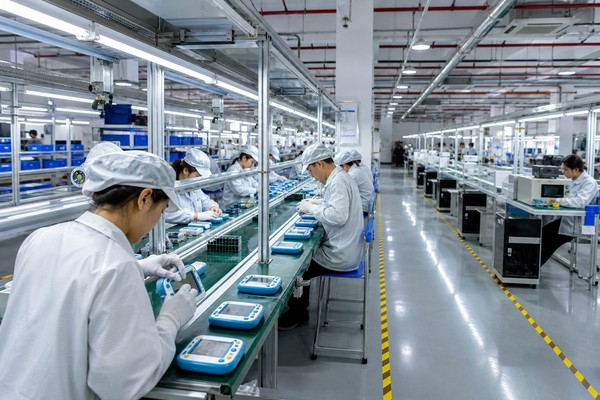
Many B2B buyers ask: “Why can’t a factory just print 200 custom card decks for my brand?” To understand this, it is essential to look at the manufacturing process of educational electronic toys from the factory floor.
Raw Material Sourcing and Supplier MOQs
A talking flash card device consists of multiple components: the ABS plastic shell, the PCB (Printed Circuit Board), the speaker, the rechargeable lithium battery (or AAA battery compartment), and the IC audio chip. Toy factories do not manufacture all these components in-house; we source them from specialized sub-contractors. These component suppliers have their own strict MOQs. For instance, audio IC chip manufacturers rarely accept custom programming orders for fewer than 2,000 to 3,000 units per batch.
Printing Setup and Waste
Printing custom flash cards requires industrial offset printing presses (such as Heidelberg machines). The setup process for these machines—including plate-making, color calibration, and ink adjustment—is highly labor-intensive and costly. During the calibration phase, hundreds of sheets of paper are wasted before the colors align perfectly. If a factory runs a batch of only 200 decks, the cost of setup and wasted paper would exceed the actual value of the order.
Safety and Certification Compliance
Children’s toys are subject to strict international safety standards, such as ASTM F963 in the United States [2] and EN71 in the European Union [3]. Compliance requires the use of non-toxic, eco-friendly materials, including soy-based safety inks and heavy-metal-free plastics. Testing and certifying these materials in third-party labs (like SGS or TÜV) is expensive. High-volume production allows manufacturers to amortize these compliance and testing costs over thousands of units, keeping the unit price competitive.
3. How to Negotiate Lower MOQs with a Shenzhen Toy Factory
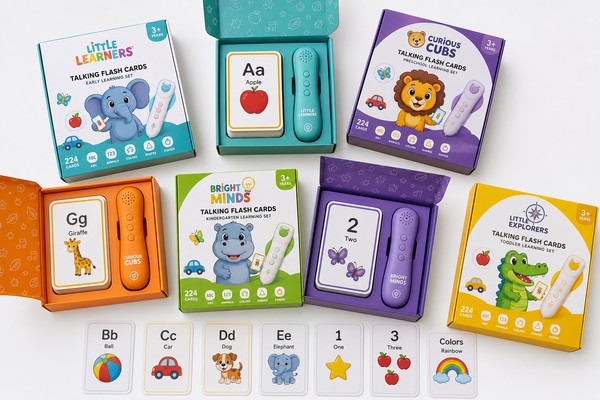
If your initial budget does not support a 3,000-unit order, you do not have to abandon your project. There are several proven industry strategies to negotiate lower MOQs while still achieving a customized look for your brand.
Strategy A: Utilize Public Molds (OEM) Instead of Private Molds (ODM)
Developing a custom plastic injection mold for a unique card reader design can cost anywhere from $8,000 to $25,000 and requires a high MOQ to justify. Instead, choose a “public mold”—a design that the factory already owns and produces. You can still customize the color of the plastic shell, apply your brand logo via silk-screen printing, and customize the card content, which keeps the MOQ around 1,000 units.
Strategy B: Customize the Packaging, Keep the Product Standard
If you want to test the market with a low MOQ (e.g., 500 units), you can source our standard, high-selling talking flash card reader and card decks, but customize only the external packaging. We can apply a custom-designed sleeve or sticker to our standard box, or print a custom-branded box at a local packaging supplier (where printing MOQs are lower) and assemble them in our factory.
Strategy C: Commit to an Annual Volume with Split Shipments
If you know you will need 3,000 units over the course of a year, you can negotiate a contract for 3,000 units to secure the bulk pricing and custom chip programming, but request the factory to produce and ship them in smaller batches (e.g., 1,000 units every 4 months). This reduces your immediate warehousing costs and improves your cash flow.
4. Why Toyvao is Your Ideal Partner for Flexible B2B Sourcing
Based in Shenzhen, the global hub of electronic toy manufacturing, Toyvao is a direct factory specializing in children’s educational talking flash cards and walkie talkies. We understand the challenges that international importers, Amazon sellers, and educational startups face when sourcing from China.
Unlike trading companies that mark up prices and enforce rigid terms, Toyvao offers:
– Direct Factory Pricing: Eliminate middlemen and maximize your profit margins.
– Flexible MOQ Solutions: We offer low MOQs starting at 500-1,000 units for customized packaging and OEM orders.
– Strict Quality Control & Safety Standards: Our products are manufactured using non-toxic ABS plastic and soy inks, fully complying with ASTM F963, EN71, CE, FCC, and RoHS certifications.
– End-to-End OEM/ODM Services: From custom bilingual audio chip programming (English, Spanish, French, Arabic, etc.) to custom mold design, our in-house R&D team is equipped to bring your vision to life.
By choosing Toyvao, you partner with a manufacturer that values long-term growth over one-off transactions. We help you scale your brand safely, efficiently, and cost-effectively.
Contact Our Sourcing Team Today
Are you ready to launch your custom talking flash card brand? Contact our factory representatives today for a free quotation, product catalog, and samples.
- Email: info@toyvao.com
- WhatsApp: +86 186 8106 4480
- Website: https://toyvao.com
References
- Grand View Research. (2024). Educational Toys Market Size, Share & Trends Analysis Report by Product, by Age Group, by Distribution Channel, and Segment Forecasts 2025 – 2030. Grand View Research Educational Toys Market
- ASTM International. (2023). ASTM F963-23 Standard Consumer Safety Specification for Toy Safety. ASTM Toy Safety Standard
- European Committee for Standardization. (2024). EN 71: Safety of Toys. CEN EN 71 Toy Safety Standards
