When importing children’s electronic educational toys in bulk, product quality and safety compliance are the ultimate deciding factors for business longevity. Regulatory bodies worldwide, such as the U.S. Consumer Product Safety Commission (CPSC) and European Union customs, are increasingly vigilant about toy safety imports [1]. Non-compliant shipments can lead to costly customs seizures, heavy fines, and devastating product recalls.
Furthermore, early childhood development experts, including those at the American Academy of Pediatrics (AAP), emphasize that electronic toys must be structurally robust and chemically safe, as toddlers frequently put these items in their mouths [2].
For B2B toy distributors, educational institutions, and brand owners, establishing a rigorous quality control (QC) checklist for bulk Talking Flash Cards sourcing is vital. This guide outlines the essential quality standards, chemical compliance regulations, and quality testing methods that every premium manufacturer must adhere to.
1. Material and Chemical Safety Compliance
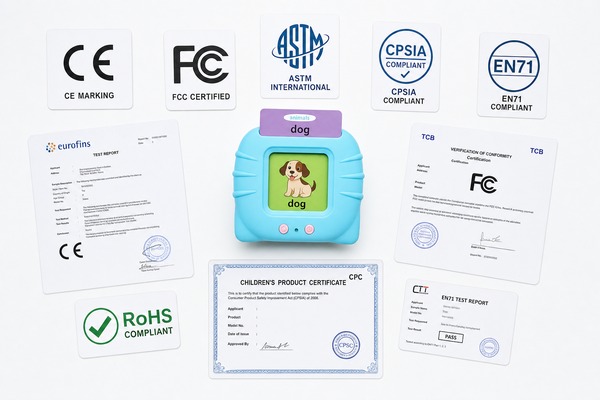
The materials used in manufacturing talking flash cards must be 100% non-toxic, lead-free, and phthalate-free. Here are the primary international safety frameworks your manufacturer must comply with:
- United States (ASTM F963 & CPSIA): Regulates physical hazards, flammability, heavy metals, and phthalate content in children’s toys [3].
- European Union (EN71 & CE): Specifies safety requirements for mechanical/physical properties, flammability, and migration of certain chemical elements [4].
- RoHS & WEEE: Since talking flash cards contain electronic PCB boards and batteries, they must comply with RoHS directives restricting hazardous substances in electrical equipment.
2. Structural and Electronic Quality Standards
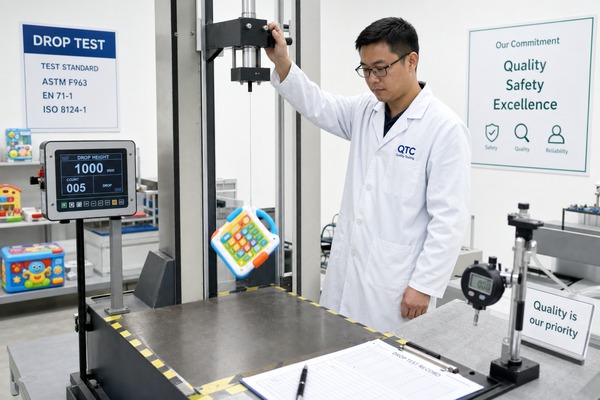
A premium talking flash card device must survive the rough handling of toddlers. Quality manufacturers like Toyvao implement strict engineering standards across three key areas:
A. Battery Safety (Rechargeable Lithium-Polymer)
If the device uses a rechargeable lithium battery, the battery cell must have overcharge, over-discharge, and short-circuit protection. It must be certified under UN38.3 (safe transport of lithium batteries) and IEC 62133 standards.
B. Card Durability and Non-Toxic Printing
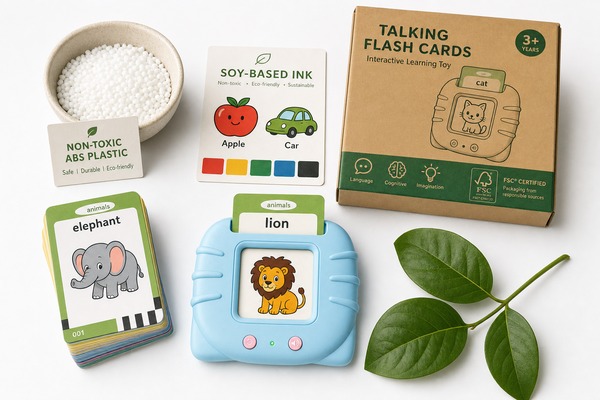
Cards must be printed using eco-friendly soy-based inks or food-grade water-based varnishes. They must have rounded corners to prevent scratching and be laminated with a matte film to ensure water resistance, tear resistance, and anti-glare protection for children’s eyes.
C. Acoustic Decibel Limits
The maximum sound output of the speaker must not exceed 85 decibels (dB) at a distance of 25cm, complying with ASTM F963 acoustic safety guidelines to prevent damage to children’s sensitive hearing.
3. Quality Comparison Checklist: Sourcing Standards
The table below serves as a quality audit checklist to evaluate suppliers during your sourcing process.
| Testing Category | Standard Sourcing Requirement | Premium Manufacturer (Toyvao Standard) | Budget Supplier (Common Issues) |
|---|---|---|---|
| Drop Test | Device must remain functional after 5 drops from 1.5 meters onto concrete. | Passed: Internal PCB and battery are secured with shock-absorbing silicone brackets. | Failed: Cheap plastic casing cracks, speaker wires detach, battery loose. |
| Tension Test | Card slot and buttons must withstand 50N of pulling force. | Passed: Buttons are integrated into the main shell with reinforced internal structures. | Failed: Buttons pop out easily, presenting a severe choking hazard. |
| Chemical Safety | Zero lead, phthalates, or toxic heavy metals. | Certified: 100% Virgin ABS plastic with SGS/TUV testing reports. | Risky: Uses recycled plastics containing trace heavy metals; no valid lab reports. |
| Battery Life | Battery must retain >80% capacity after 300 charge cycles. | Passed: Uses premium A-grade lithium-polymer cells with protective IC. | Failed: Cheap B-grade batteries degrade within 2 months, swelling hazard. |
| Card Reading Accuracy | Optical sensor reading rate should be >99.9%. | Passed: High-precision infrared sensor paired with error-correction algorithms. | Failed: Frequent misreadings or failure to play sound when card is bent. |
4. Factory Quality Control Workflow
A reliable factory must perform rigorous testing on every production batch. At Toyvao, our quality control workflow is divided into three major stages to ensure a 99.7% pass rate:
Toyvao Factory Quality Control (QC) Flow
├── 1. IQC (Incoming Quality Control)
│   ├── Testing raw ABS plastics for chemical purity
│   └── Testing PCB boards, speakers, and battery cells
├── 2. IPQC (In-Process Quality Control)
│   ├── Solder joint inspection on SMT assembly line
│   └── Audio playback and decibel testing on semi-finished devices
└── 3. FQC & OQC (Final & Outgoing Quality Control)
    ├── 1.5m drop testing and high-temperature aging tests
    └── AQL 1.5 standard sampling inspection before shipping
5. Source Certified, High-Quality Talking Flash Cards with Toyvao!
Don’t compromise your brand’s reputation with low-cost, uncertified learning toys. Toyvao is a fully certified, high-quality OEM/ODM factory specializing in premium children’s educational electronics. We provide complete compliance documentation (ASTM, EN71, CE, CPC, FCC, RoHS) for seamless customs clearance and retail peace of mind.
Partner with us for safe, durable, and highly rated educational products. Contact our quality assurance team today for a factory audit report and certified product samples:
- Email: info@toyvao.com
- WhatsApp: +86 186 8106 4480
- Website: https://toyvao.com
References
- U.S. Consumer Product Safety Commission (CPSC). (2024). Toy Safety Alerts and Import Compliance Guidelines. https://www.cpsc.gov
- American Academy of Pediatrics (AAP). (2023). Preventing Choking and Chemical Exposure from Toys. https://www.aap.org
- ASTM International. (2023). Standard Consumer Safety Specification for Toy Safety (ASTM F963-23). https://www.astm.org
- European Committee for Standardization (CEN). (2024). Safety of Toys – Part 1, 2 & 3 (EN71). https://www.cen.eu
